Short answer: Make sure AI search crawlers are allowed to read your site, make sure Google and Bing have indexed it, describe your business the same clear way everywhere, and write pages that answer real questions in their first sentences. Then get mentioned on other sites people trust: directories, review platforms, partners, articles. Nobody can guarantee an assistant will name you, because the answers change from one question to the next.
A customer who used to type "accountant for small restaurants" into Google now asks ChatGPT the same thing, gets a short answer with three names in it, and never sees a list of ten links. If your business isn't one of the three, that customer doesn't know you exist.
Whether you call it showing up in ChatGPT, how to appear in ChatGPT or how to get found on ChatGPT, the steps are the same. There's a whole new industry selling "AI optimisation" for this. Most of what actually helps is less exotic than it sounds, and some of it is the same work that has always helped in ordinary search.
Want to know where your own site stands? The $49 website and SEO audit checks indexing, crawler access and the pages search tools quote, and you get a written report within 3 working days. Or start with the free website check.
Where do AI assistants get their answers from?
When an assistant answers a question about businesses or services, it usually searches the web first and builds the answer from what it finds, often with links to the sources. That's the part you can influence. The other part, what a model learned during training, is out of your hands and quickly goes out of date.
- Google AI Overviews and AI Mode come from Google's own index. Google's documentation says a page has to be indexed and eligible to show a snippet, and that no special files or markup are required.
- ChatGPT search uses OpenAI's search crawler. OpenAI's crawler page lists it as OAI-SearchBot, separate from GPTBot, which collects training data.
- Claude has separate crawlers for training, for search and for fetching a page a user asked about, described in Anthropic's help article.
- Microsoft Copilot draws on Bing, so a site that Bing hasn't indexed is at a disadvantage there.
- Perplexity runs its own crawler, PerplexityBot.
Can AI crawlers read your site?
Open yourdomain.com/robots.txt. If it blocks everything, or blocks the search crawlers by name, the assistants that respect it can't use your pages. Some website builders and security plugins added AI blocking rules by default, so check even if nobody on your team remembers touching the file.
You can treat training and search separately. Blocking GPTBot keeps your pages out of OpenAI's training data. Blocking OAI-SearchBot keeps them out of ChatGPT's search answers, which is usually the opposite of what a business wants. Decide on each one deliberately rather than copying a list from a forum.
A firewall can block crawlers too, even when robots.txt allows them. If your hosting has bot protection switched on, look at what it does with these crawlers.
Is your site in Google and Bing?
An assistant that searches the web can only find what the search index has. Check Google with Search Console and Bing with Bing Webmaster Tools, which is free and often forgotten. If pages are missing, the causes are the same ones we listed in why a website isn't showing up on Google.
Does your site say clearly who you are?
An assistant has to decide what your business is before it can recommend it for anything. Make that easy:
- One plain description, used everywhere. What you do, for whom and where, in one sentence. Use the same sentence on your homepage, your about page, your Google Business Profile, LinkedIn and any directory you're listed in.
- Facts on the page, not only in pictures. Services, locations, opening hours, the areas you serve and how to contact you, written as text a crawler can read.
- Structured data. Organization or LocalBusiness markup with your name, address, logo and links to your profiles. It doesn't guarantee anything, but it removes guesswork.
- The same details everywhere. If your address or service list differs between your site and your profiles, an assistant may pick the wrong one, or trust neither.
Do your pages answer questions directly?
Assistants quote passages. A page that opens with two paragraphs about your passion for excellence gives them nothing to quote. A page that answers the question in its first sentence does.
- Use the questions customers really ask as headings, and answer each one in the first sentence or two below it.
- Be specific. "We repair flat roofs in Leeds, usually within a week of the survey" can be quoted. "Quality roofing solutions" can't.
- Give each service its own page, so the answer to "who does X near Y" has one obvious source.
- Say what you don't do as well. It helps the assistant send the right people to you.
Are you mentioned anywhere else?
This is the part most businesses skip, and it matters a lot. When an assistant chooses which businesses to name, it leans on what other sites say about them: review platforms, industry directories, local news, partner sites, comparison articles. A business that only describes itself on its own website is easy to overlook.
The honest ways in are the same as for ordinary search: a Google Business Profile if you serve a local area, the directories your industry actually uses, reviews from real customers, and partners who link to you because you work together. Paid lists of hundreds of links do nothing useful.
Can you submit your website to ChatGPT or get listed in it?
Not directly. As far as we know, there is no form that adds a business to ChatGPT's answers, and no listing you can buy that puts you inside them. ChatGPT finds pages the way a search engine does, through its search crawler, so "getting listed" means doing the steps above: let OAI-SearchBot in, get indexed, and be clear and quoted elsewhere.
What you can submit is your site to the search engines the assistants lean on. Add your sitemap in Google Search Console and in Bing Webmaster Tools, which also feeds Microsoft Copilot. If your site supports IndexNow, Bing and several other search engines hear about a new or changed page the moment it is published, instead of waiting for the next crawl.
Be wary of anyone who promises a guaranteed spot in ChatGPT answers. Nobody outside the companies that run these assistants controls what they say, and the answer to the same question changes from day to day.
What does this look like on a real site?
One example from our own work: Matted Hair London, a hair studio in south-east London. Its site had one list of confirmed facts used on every page, structured data that described the business once, and FAQ answers that opened with a direct reply. In a check on 21 July 2026, for one of the questions we tracked, five of the six sources Google's AI Overview cited were pages from matted.co.uk.
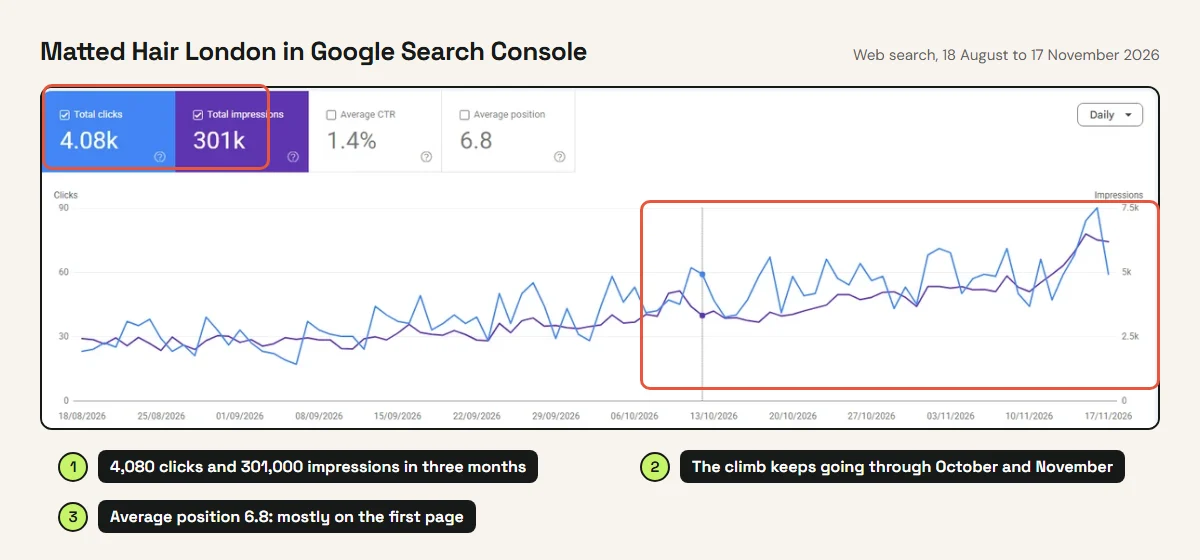
That was one question on one day, and AI answers move around, so it is a sign that the approach works rather than a promise. The full write-up, with what was done and the Search Console numbers, is in the Matted Hair London case study.
What about llms.txt?
llms.txt is a proposed file that gives AI tools a short, plain summary of a site. It's cheap to add and we use one on this site. As far as we know, none of the big assistants has said it relies on the file, so treat it as a small extra, not the thing that gets you mentioned.
How do you know if it's working?
- Ask the assistants. Try the questions your customers would ask, in a private window, and note who gets named. Answers vary, so try each question a few times and on more than one assistant.
- Check your analytics. Visits that come from chatgpt.com, perplexity.ai, copilot.microsoft.com and similar addresses show up as referrals.
- Check Search Console. Google counts clicks from its AI features inside the normal web search report, so growth there includes them.
Expect this to be slow and uneven, especially for a new site. It builds on the same things as search: being indexed, being clear and being trusted by other sites.
Making a site easy for search engines and AI assistants to read and quote is part of our SEO service. If you want to know where your site stands first, send us the address for a free website check.
Sources
- Google Search Central, AI features and your website: pages must be indexed and eligible for a snippet, no special files or markup are needed, and AI feature traffic is counted in the Performance report under Web.
- OpenAI, Overview of OpenAI crawlers: OAI-SearchBot for ChatGPT search and GPTBot for training, set independently in robots.txt.
- Anthropic, Does Anthropic crawl data from the web, and how can site owners block the crawler?: ClaudeBot, Claude-SearchBot and Claude-User.
- Microsoft Learn, Data, privacy, and security for web search in Microsoft Copilot and Microsoft Copilot Chat: Copilot sends search queries to the Bing search service and uses the results in its answers.
- Bing Webmaster Blog, Keeping content discoverable with sitemaps in AI powered search, 31 July 2025: submitting sitemaps in Bing Webmaster Tools, alongside IndexNow, for search and Copilot.
- IndexNow, FAQ: a URL submitted to one participating search engine is shared with all of them.
- llmstxt.org, The /llms.txt file: the proposal for a plain summary file aimed at AI tools.